
Carbon Nanotubes Provide Key to Lawrence Livermore Smart Window Technology
LIVERMORE, Calif., Sept 15, 2025 — Half of the sun’s radiant energy falls outside of the visible spectrum. On a cold day, this extra infrared light provides additional warmth to residential and commercial buildings. On a warm day, it leads to unwanted heating that must be dealt with through energy-intensive climate control methods, like air-conditioning.
Visibly transparent “smart windows” capable of modulating the transmission of near infrared light offer a potential cost- and energy-saving measure for modern infrastructure.
To work toward solving this technological challenge, a multidisciplinary team of researchers at Lawrence Livermore National Laboratory (LLNL) developed an electrically controlled, near-infrared smart window that can cut near-infrared transmission by close to 50%. The secret is vertically-aligned carbon nanotubes — tiny tube-shaped structures made from carbon atoms
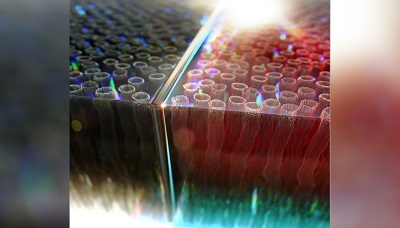
LLNL researchers have developed smart windows with vertically aligned carbon nanotubes that can modulate the transmission of near-infrared light, potentially cutting costs and energy usage in modern infrastructure. Courtesy of LNLL.
In these smart widows, the carbon nanotubes are grown so they stand upright on the glass, like a microscopic forest. The team noted that devices fabricated in the research are just millimeters in size, acknowledging that the technology will have to be scaled up as a next step.
The nanotubes can absorb infrared light and block heat from the sun or let the infrared light through depending on the applied voltage. Once the tubes are put into either a blocking or transparent state, they retain charge well, meaning that a continuous voltage isn't necessary to maintain that state. This enables low-power operation, reducing energy costs.
To come up with this design, the researchers coupled experimental fabrication and measurements from modeling efforts to better understand the microscopic physics that drive the tunable infrared response, yielding new insights into the optical and electronic physics of vertically aligned carbon nanotubes. The work, they said, builds on nearly a decade of LLNL research into the synthesis and study of vertically aligned carbon nanotubes.
The research was published in Nano Letters (www.doi.org/10.1021/acs.nanolett.5c00059).
Published: September 2025