Photonics HandbookResearch & Technology
Chirped Laser Captures Spatiotemporal Plasma Dynamics in Single Shot
LIVERMORE, Calif., Sept. 30, 2025 — Understanding the properties of plasma, the fourth state of matter, is critical to deploying it in technologies as diverse as fusion energy, astrophysical modeling, and semiconductor manufacturing. However, gaining insight into plasma dynamics, which can unfold in trillionths of a second, requires a robust approach.
Underdense plasmas — that is, plasmas that are optically transparent to the probe beam — span spatial scales from microns to meters (μm to m), and evolve over timescales from femtoseconds (fs) to microseconds (μs). They can exhibit rapid oscillations and turbulent flows and show extreme sensitivity to various conditions.
To capture such rapid and unpredictable events with high fidelity, researchers at Lawrence Livermore National Laboratory (LLNL) developed a diagnostic for measuring the spatiotemporal evolution of plasma density in a single laser shot. The diagnostic, called Single-shot Advanced Plasma Probe HolographIc REconstruction (SAPPHIRE), creates movies of plasma changes with 100 billion frames per second, showing ultrafast dynamics that were previously impossible to observe.
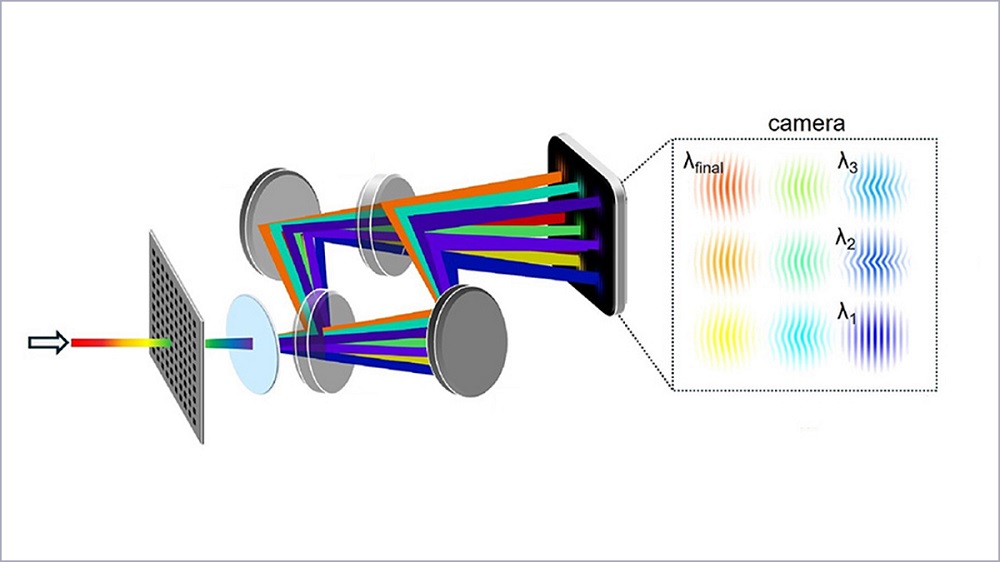
A schematic of the Single-shot Advanced Plasma Probe HolographIc REconstruction (SAPPHIRE) diagnostic. The top half of a chirped laser beam passes through plasma, while the bottom half does not. Separating and recombining the beam creates interference patterns (right) that show how the plasma changes with time. Courtesy of Grace et al., Optica, “Single-shot spatiotemporal plasma density measurements with a chirped probe pulse,” (2025).
Unlike conventional diagnostic tools, SAPPHIRE does not depend on information that is obtained across different, discrete shots. It overcomes limitations like reliance on shot-to-shot reproducibility, while capturing plasma dynamics on ps timescales with μm-level spatial resolution.
“In most high-energy, high-intensity laser experiments currently, we take a single image per laser shot,” researcher Liz Grace said. “However, these plasmas are unstable and unpredictable, and small changes can have butterfly effects that impact the subsequent evolution. It’s important to capture as much information at once as possible.”
The single-shot approach uses a chirped probe pulse, a diffractive optical element, a self-referenced interferometer, and an interference bandpass filter to achieve high-fidelity electron density measurements for underdense plasmas that exhibit cylindrical symmetry.
The upper half of a chirped laser beam passes through the plasma, where it refracts and warps. The lower half of the beam does not traverse the plasma. At the other end of the plasma, the SAPPHIRE diagnostic separates the two beam halves, then recombines them to create an interference pattern for each wavelength of light, providing a timestamp that records how the plasma changes over time.
Using mathematical analyses, the researchers can convert the interference patterns to a map of the electron density in the plasma, and obtain a detailed movie of how the plasma changes with time. The SAPPHIRE diagnostic captures electron density distributions on highly flexible spatial and temporal scales, enabling the reconstruction of 3D electron density profiles in a single shot.
The researchers used the diagnostic to investigate laser-driven plasma channel dynamics in helium-nitrogen gas mixtures. SAPPHIRE showed the formation and expansion of plasma channels in a single shot and the propagation of supersonic ionization fronts, while revealing shot-to-shot variations in the plasma profiles. The researchers validated the experimental results against theoretical models and scaling laws to confirm the robustness and accuracy of the technique. The experimental results showed good agreement with theoretical predictions and provided new insights into shot-to-shot fluctuations in plasma behavior.
The significant fluctuations observed by the researchers between nominally identical laser shots reinforced their belief in the necessity of single-shot diagnostics. Traditional multi-shot averaging cannot capture the true variability of plasma dynamics, given the chaotic nature of plasma.
Although SAPPHIRE was tested on helium-nitrogen gas jets, the researchers said that the diagnostic also could be used to measure time-dependent, underdense plasma profiles that are created in pulsed power, waveguides, plasma optics, laser-based particle accelerators, as well as by other means.
By enabling ultrafast, high-resolution plasma diagnostics in a single exposure, SAPPHIRE could enhance and advance plasma measurement technology significantly.
“I personally would love to see this diagnostic applied to fusion energy environments, including Z-pinch plasmas,” Grace said. “In the paper, we provided a very thorough instruction manual of how to build your own, and I’m looking forward to seeing what people can come up with.”
The research was published in Optica (www.doi.org/10.1364/OPTICA.566848).
Published: September 2025