
LIGO Receives Performance Boost from Sophisticated AI
The Laser Interferometer Gravitational-Wave Observatory (LIGO), makes measurements of motions that >10,000× smaller than the width of a proton. It is this level of precision that enables LIGO to detect gravitational waves — undulation in space-time that roll outward from colliding cosmic bodies such as black holes.
Improvements since the observatory’s establishment have boosted its interferometers, enabling LIGO it to detect an average of about one black hole merger every three days during its current science run. Now, researchers want to further enhance LIGO’s capabilities to allow it to detect a larger variety of black hole mergers, including more massive mergers that might belong to a hypothesized intermediate-mass class bridging the gap between stellar-mass black holes and much larger supermassive black holes residing at the centers of galaxies. Such advancements would also make it easier for LIGO to find black holes with eccentric, or oblong orbits, as well as catch mergers earlier in the coalescing process, when the dense bodies spiral in toward one another.
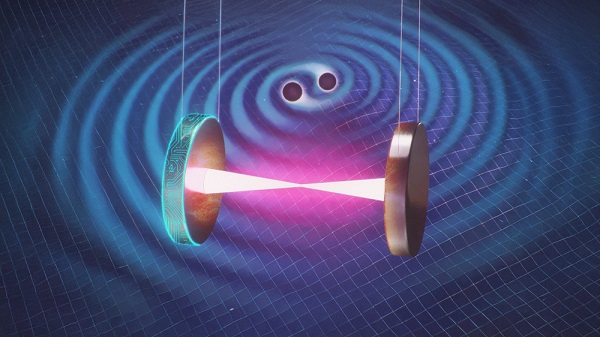
Artist’s impression of how gravitational wave observatories are used to observe the universe. Courtesy of Google DeepMind.
To this end, researchers at Caltech and Gran Sasso Science Institute (GSSI, Italy) collaborated with Google DeepMind to develop an AI method that makes it possible to further reduce unwanted noise in LIGO’s detectors. Called Deep Loop Shaping, the AI algorithm has been shown to quiet the motions of the LIGO mirrors by 30-100× more than what’s possible with traditional noise-reduction methods alone.
While noise can refer to any number of disturbances that interfere with data collection, for LIGO, the term often refers to a tiny amount of jiggling in the large glass mirrors at the heart of LIGO. “If you imagine trying to hold these mirrors very tightly, your hands might start to shake," said Rana Adhikari, a professor at Caltech involved in the research. The developed method, Adhikari said, aims to reduce that shaking, as too much of that shaking can mask gravitational wave signals.
“This technology will help us not only improve LIGO but also to build next-generation, even bigger gravitational-wave detectors,” Adhikari said.
The method is still in a proof-of-concept stage; so far, its developers have tested it on LIGO for only an hour to demonstrate that it works. The team is looking forward to conducting longer duration tests and ultimately implementing the method on several LIGO systems.
“This is a tool that changes how we think about what ground-based detectors are capable of,” said co-author Christopher Wipf, a gravitational-wave interferometer research scientist at Caltech.
The approach could also improve technologies that use control systems. “In the future, Deep Loop Shaping could also be applied to many other engineering problems involving vibration suppression, noise cancellation and highly dynamic or unstable systems important in aerospace, robotics, and structural engineering,” wrote study co-authors Brendan Tracey and Jonas Buchli, an engineer and scientist, respectively, at Google DeepMind, in a blog post about the study.
Adhikari noted precision lithography for chip-making as another potential area of application.
Still Reflections
Both the Louisiana and Washington LIGO facilities are shaped like enormous “Ls,” in which each arm of the "L" contains a vacuum tube that houses advanced laser technology. Within the 4-km-long tubes, lasers bounce back and forth with the aid of giant 40-kg suspended mirrors at each end. As gravitational waves reach Earth from space, they distort space-time in such a way that the length of one arm changes relative to the other by infinitesimally small amounts — the system has an accuracy down to 1/10,000 the size of a proton. LIGO's laser system detects these minute, subatomic-length changes to the arms, registering gravitational waves.
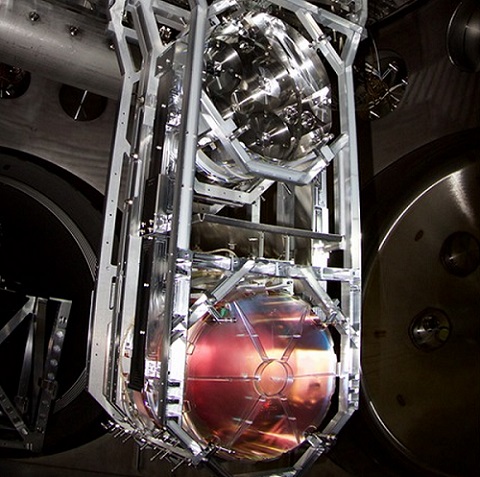
LIGO uses strong lasers and mirrors to detect gravitational waves in the universe, generated by events like collisions and mergers of black holes. Courtesy of Caltech/MIT/LIGO Lab.
But to achieve this level of precision, engineers at LIGO must ensure that background noises are kept at bay. This study looked specifically at unwanted noises, or motions, in LIGO's mirrors that occur when the mirrors shift in orientation from the desired position by very tiny amounts. Although both of the LIGO facilities are relatively far from the coast, one of the strongest sources of these mirror vibrations is ocean waves.
“It's as if the LIGO detectors are sitting at the beach,” said Wipf. “Water is sloshing around on Earth, and the ocean waves create these very low-frequency, slow vibrations that both LIGO facilities are severely disturbed by.”
The solution to the problem works much like noise-canceling headphones, Wipf said.
“Imagine you are sitting on the beach with noise-canceling headphones. A microphone picks up the ocean sounds, and then a controller sends a signal to your speaker to counteract the wave noise,” he said. “This is similar to how we control ocean and other seismic ground-shaking noise at LIGO.”
However, as is the case with noise-canceling headphones, there is a price.
“If you have ever listened to these headphones in a quiet area, you might hear a faint hiss. The microphone has its own intrinsic noise. This self-inflicted noise is what we want to get rid of in LIGO,” Wipf said.
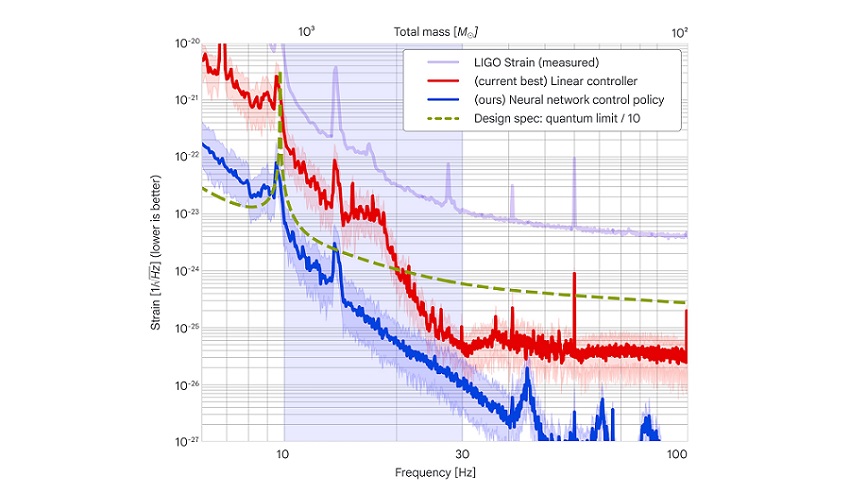
A line chart showing the resulting control noise spectrum using the Deep Loop Shaping method. The algorithm achieved an improvement of 30-100× in the injected control noise in the most unstable and difficult feedback control loop. Courtesy of Google DeepMind.
LIGO’s traditional feedback control system senses the vibrations in the mirror caused by seismic noise and counteracts them, but in a way that introduces a new higher frequency vibration. The controller senses these high frequency vibrations and constantly reacts to both types of disturbances to keep the mirrors as still as possible. This type of system is sometimes compared to a waterbed: Trying to quiet waves at one frequency leads to extra jiggling at another frequency. Controllers can automatically sense the disturbances and stabilize a system.
Adhikari wanted to further improve the LIGO control system, in particular to reduce the controller-induced hiss, which interferes with gravitational-wave signals in the lower-frequency portion of the observatory's range. LIGO detects gravitational waves with a frequency between 10 and 5000 Hz. The unwanted hiss lies in the range between 10 and 30 Hz — and this is where more massive black holes mergers would be picked up, as well as where black holes would be caught near the beginning of their final death spirals (for instance, the famous “chirps” heard by LIGO start in lower frequencies then rise to a higher pitch.)
Now, roughly four years after the launch of the Caltech-GSSI collaboration, the team has deployed the technique of reinforcement learning to, essentially, teach the AI algorithm how to better control the noise.
“This method requires a lot of training,” Adhikari said. “We supplied the training data, and Google DeepMind ran the simulations. Basically, they were running dozens of simulated LIGOs in parallel. You can think of the training as playing a game. You get points for reducing the noise and dinged for increasing it. The successful ‘players’ keep going to try to win the game of LIGO."
The result, Adhikari said, is an effective, algorithm-based suppression of mirror noise.
Published: September 2025