Prism-Based Cameras
One of the newer entrants to the line-scan landscape is the prism-based camera. At present, one of the only companies that offers such a device is JAI. This type of camera is useful when the speed of the object is uncertain. JAI’s director of product management, Paritosh Prayagi, provided the example of inspecting potatoes.
“The objects are not stable, [and] they’re also vibrating, moving, rotating, and so on,” he said. “When you have these objects moving at different speeds, that’s when prism technology is very helpful. Because, unlike the traditional color line-scan cameras, which are the trilinear cameras, we don’t have any kind of a line gap on the sensors.”
A traditional trilinear camera focuses on separate lines for red, green, and blue, and in between them are gaps, Prayagi said.
“If the object speed is changing too frequently, then the RGB lines are not able to overlap onto each other at the right time,” Prayagi said. “If there’s a signal frequency mismatch, this can lead to something called a halo effect.”
In an RGB prism camera, the light is sent to three separate sensors simultaneously,
eliminating the possibility of a color mismatch that can occur in a trilinear camera. However, with the increased number of sensors — and, of course, the prism itself — comes an increased cost.
“It’s not applicable for each and every line-scan application, but an application where the value is there, I think the cost doesn’t play a big role,” Prayagi said.
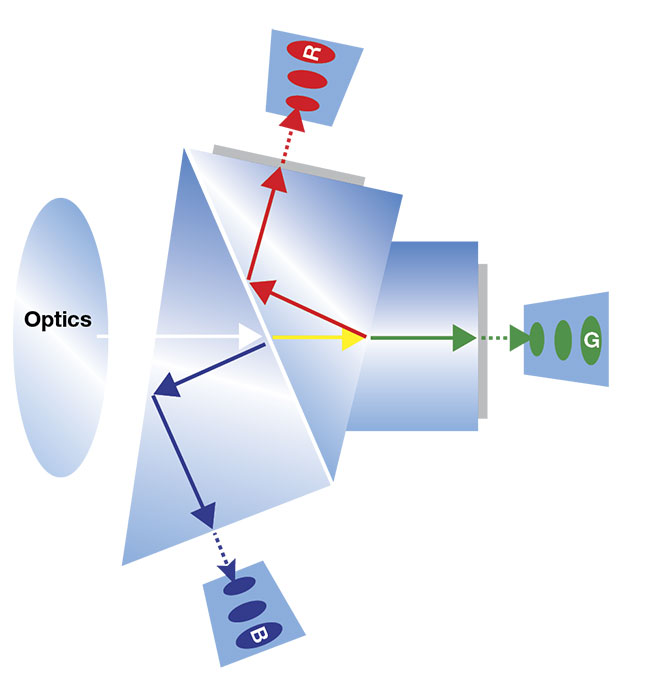
The separation of light inside a prism block. Courtesy of JAI.
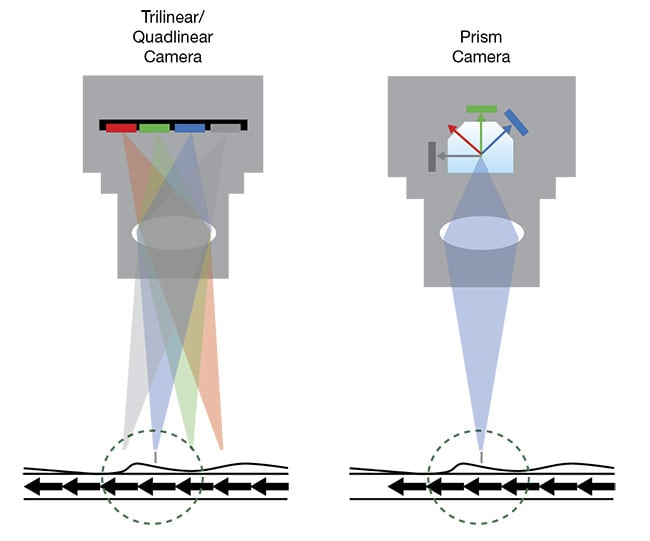
The individual lines in a trilinear camera are separated from each other by a line gap that can be one pixel or smaller, creating a slight optical shift for each of the colors. Courtesy of JAI.
|