
Live Cell Superresolution Method Enables Full Range of Biological Mechanism Imaging
LONDON, Aug. 18, 2025 — Researchers introduced a superresolution imaging technique that visualizes live, dynamic cellular structures at 60-100 nm while significantly reducing the risk of damaging the fragile cells. The microscopy advancement could inform research into DNA repair, chromosome activity, and other biological mechanisms.
The imaging approach, developed by a team at Queen Mary University of London in collaboration with industry partners, combines Fluorescence Recovery After Photobleaching (FRAP) with Lattice Structured Illumination Microscopy (diSIM/SIM2). The resulting application is named FRAP in the Superresolution regime (FRAP-SR).

Full nuclei exhibiting DNA damage, marked by green, cloud-like 53BP1 foci. Courtesy of Queen Mary University of London.
“Our FRAP-SR approach enables us to visualize structures as small as 60 nanometers within living cells — a scale previously inaccessible for dynamic studies without causing significant cellular stress,” professor Viji Draviam, who led the research, said. “This resolution, 2000x smaller than the width of a human hair, allows us to probe the nanoscale organization and behavior of cellular components in real time.”
Using FRAP-SR, the researchers investigated the dynamics of a protein that is key to the repair of double-strand DNA breaks, called 53BP1. They analyzed the dynamics of the 53BP1 protein within nuclear structures at 60-nm resolution. FRAP-SR enabled them to correlate protein diffusion with subcellular structural changes in the superresolution regime without perturbing the live-cell samples.
The approach revealed sub-compartments within 53BP1 foci. These sub-compartments displayed faster 53BP1 protein mobility than other foci without sub-compartments.
The researchers characterized two distinct types of 53BP1 foci that differed in their activities. Some foci appeared as stable, compact structures, while others exhibited more fluid, dynamic shapes. The compact foci displayed uniform recovery after photobleaching, but showed greater heterogeneity in the recovery rates between different foci. The amorphous foci contained discrete sub-compartments with varying protein mobility, suggesting functional specialization within these DNA repair centers.
Using lattice light-sheet movies of aphidicolin-treated cells, the researchers confirmed faster recovery of 53BP1 in amorphous foci compared to compact foci. The study also revealed that the dynamics of the foci are influenced by cellular conditions such as recovery from DNA replication stress.
The team believes that, over the long term, the combination of FRAP and diSIM will enable scientists to overcome existing limitations to examining photosensitive subcellular structures with varied protein mobilities, activities, and roles. Long-range joining of DNA breaks are important, as defective cells can experience extensive degradation of the unrepaired coding ends, leading to genomic instability.
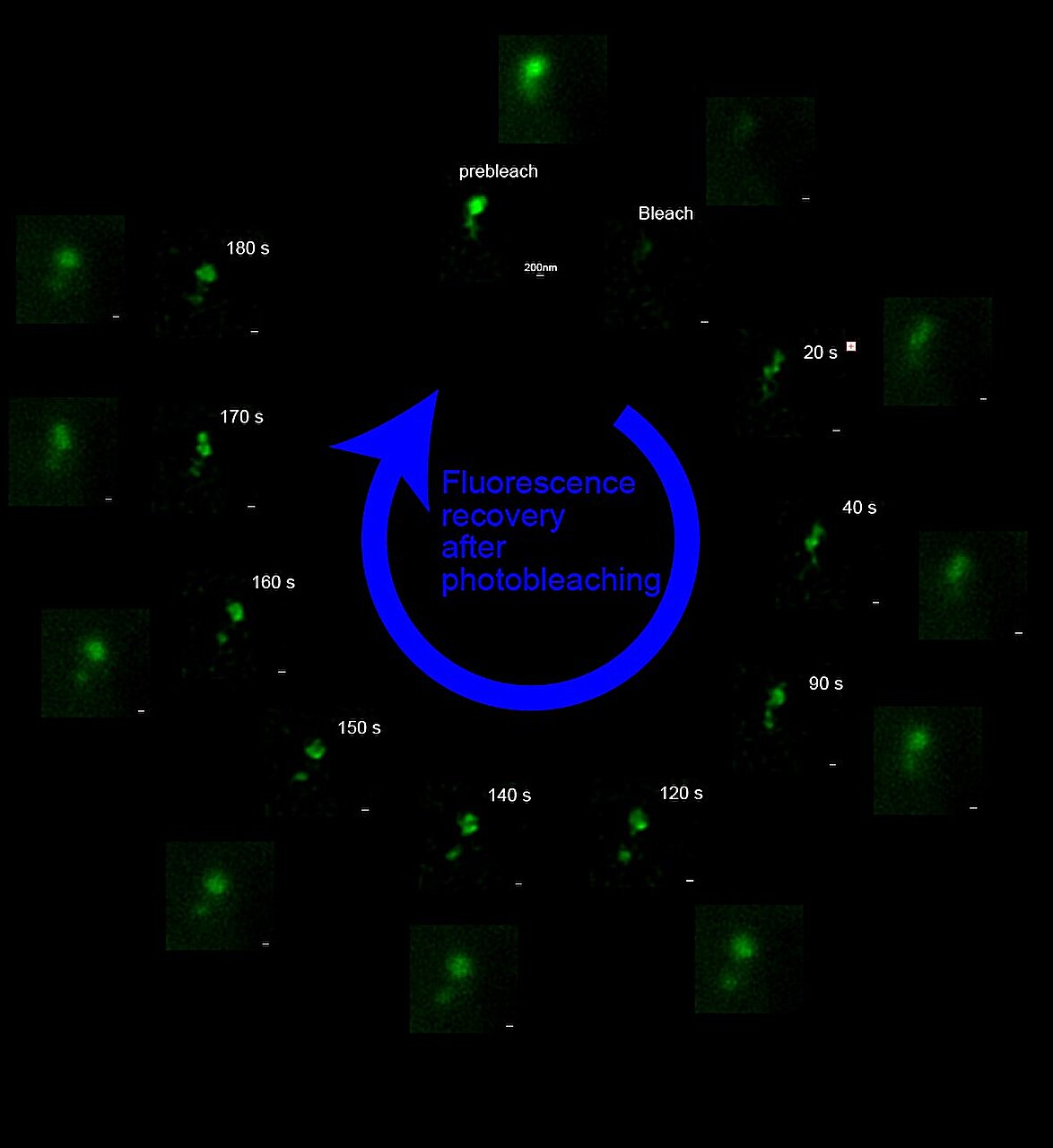
FRAP-SR tracks foci through time in seconds. The fast reappearance of the green signal after photobleaching indicates fast exchange of the protein. The sub-compartments within each foci were not previously recognized. Courtesy of Queen Mary University of London.
FRAP-SR could accelerate the development of drug targeting and drug screening methods based on live-cell dynamics. The global market for DNA repair drugs was valued at approximately $9.18 billion in 2024 and is projected to reach $13.97 billion by 2030. The use of FRAP-SR to study the DNA damage marker, 53BP1, in live cells could foster the development of DNA repair drugs and candidate drugs for personalized medicine.
“This will transform the field of optogenetics in the superresolution regime," Draviam said. "It will also enable the development of new anti-cancer drugs that target DNA damage repair pathways that are dynamic.”
The study utilized the ZEISS Elyra 7 system, enhanced with FRAP capabilities from Rapp OptoElectronics. The system provided the superresolution imaging necessary to resolve the sub-compartments of 53BP1 foci. The researchers worked with ZEISS and Rapp OptoElectronics to integrate FRAP and SIM, which allowed for precise quantification of protein dynamics.
The research was published in Cell Reports Methods (www.doi.org/10.1101/2025.05.07.652606).
/Buyers-Guide/Carl-Zeiss-Microscopy-GmbH-Microscopy/c25084
/Buyers-Guide/Carl-Zeiss-Microscopy-GmbH-Electron-and/c20191
/Buyers-Guide/Rapp-OptoElectronic/c12554