
ParTec, ORCA Computing Partner on Quantum-Accelerated AI Factories: Week in Brief: 5/9/25
EINDHOVEN, Netherlands, May 9, 2025 — imec and TNO jointly opened the Holst Centre Photonics Lab dedicated to integrated photonics research and development in the Netherlands. Located at High Tech Campus Eindhoven and partially funded by PhotonDelta, the lab aims to bridge the gap between innovation and industrialization for applications in sectors such as automotive, healthcare, and data communications, according to the organizations.
NOVI, Mich. — EOS, a supplier of additive manufacturing solutions, was awarded a contract by the U.S. Navy to support its Maritime Industrial Base (MIB) initiative to provide end-to-end laser powder bed fusion (LPBF) process training for MIB suppliers. Beginning this month, the training program will take place at the Additive Minds Academy Center in Novi, Mich., combining online coursework with hands-on experience to equip MIB suppliers with skills in additive manufacturing software, LPBF system operation, and more.
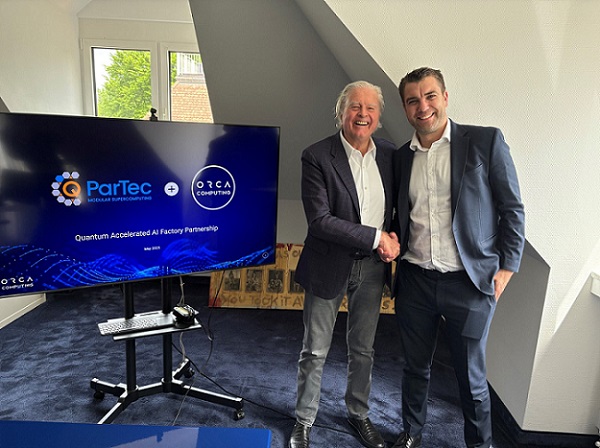
ParTec CEO Bernhard Frohwitter (left) and ORCA Computing CEO and co-founder Richard Murray. Courtesy of ORCA Computing.
LONDON — AI supercomputers and quantum computing systems designer ParTec AG entered into a partnership with photonic quantum computing company ORCA Computing to provide customers with quantum-accelerated high-performance computing and AI solution architectures. As part of the partnership, ParTec will integrate ORCA’s photonic quantum computing capabilities into its AI factory infrastructure, marking a step in expanding the practical use of quantum computing across enterprise and research applications.
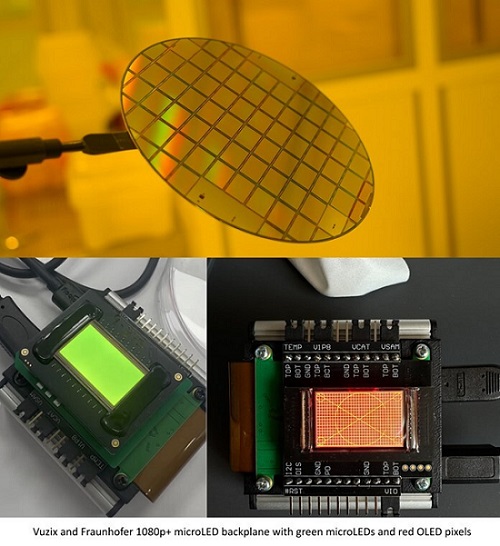
Vuzix Corporation and Fraunhofer Institute for Photonic Microsystems IPMS’ micro-LED CMOS backplane. Courtesy of Vuzix Corporation.
ROCHESTER, N.Y. — Vuzix Corporation, a supplier of AI-powered smart glasses and waveguides, and Fraunhofer Institute for Photonic Microsystems IPMS entered into a collaboration to develop a custom micro-LED backplane. The collaboration has led to the initial sample production of a high-performance micro-LED CMOS backplane that supports 1080P+ resolution, enabling both monochrome and full-color micron-sized micro-LED arrays. According to the organizations, the first working samples, tested using OLED technology, validate the design's potential for advanced display applications.
BIRMINGHAM, England — Aston University in Birmingham, England established the UK Multidisciplinary Centre for Neuromorphic Computing, which will include researchers from the University of Southampton, the University of Oxford, the University of Cambridge, Queen Mary University of London, Loughborough University, and the University of Strathclyde. Receiving £5.6 million ($7.4 million) over four years from the UKRI Engineering and Physical Sciences Research Council, the center’s aim is to make a focal point for networking and collaboration on fundamental research and technology of neuromorphic computing as well as tackle the increasing global energy footprint of information and communication technologies.
KRISTIANSUND, Norway — Lightsonic, a software company using fiber optic sensing technology, raised €3.3 million ($3.7 million) in a seed investment round to develop intelligent monitoring solutions in water utilities and critical infrastructure. The company will use the funding to accelerate product development, expand its team, and scale its technology for commercial deployment.
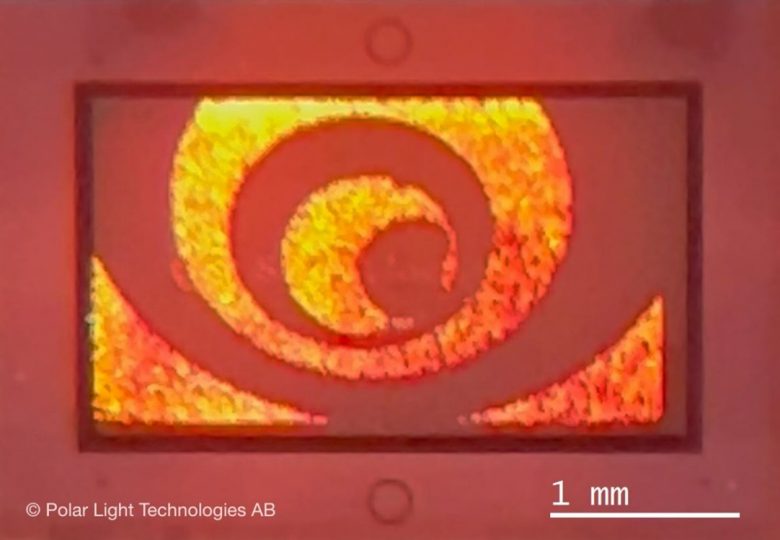
Polar Light Technologies’ first micro-display prototype. Courtesy of Polar Light Technologies.
LINKÖPING, Sweden — Pyramidal micro-LED developer Polar Light Technologies reported the successful fabrication of its first micro-display prototype built on the company’s proprietary pyramidal micro-LED. The development, which pairs a bottom-up-grown monochrome micro-LED front-plane with a SAPIEN CMOS back-plane, confirms the technology’s ability to integrate the pyramidal micro-LED frontplane onto a CMOS backplane, according to the company.
AMSTERDAM — Seaborough B.V., a nanoscience and luminescent technology developer, entered into a partnership with Luminus Devices, a lighting technologies company, to bring a LED with nano-engineered Eu3+-based phosphor to market on a commercial scale. The partnership gives Luminus early access to Seaborough’s phosphor technology, EuroLED, to test on its LED packages with the goal of creating higher quality warm white LED lighting applications.

Hub Optical Ground Station (HOGS) project lead Ross Donaldson next to the HOGS facility. Courtesy of Chris Watt Photography.
EDINBURGH, Scotland — Heriot-Watt University established the Quantum Communications Hub Optical Ground Station (HOGS) at its research park in Edinburgh, Scotland. The £2.5 million ($3.3 million) facility will add single-photon detectors and adaptive optics systems capable of exchanging quantum-encrypted information with orbiting satellites with the goal of eventually forming the backbone of a secure quantum internet within the U.K. HOGS features a 4.5-m diameter observatory dome housing a 70-cm telescope equipped with tracking systems and environmental monitoring tools and a secondary 40-cm telescope with visible and infrared cameras for space imaging and debris monitoring.
STERLING, Mass. — Innofiber, LLC, a designer and manufacturer of engineered photonic solutions, made a strategic investment in Accurate Machining, Inc d/b/a Acrolite. Acrolite designs and manufactures engineered photonic solutions including fiber optic cables, fused borosilicate fiber bundles, micro-fiber optics, and sensor assemblies and sub-assemblies for medical, industrial, and aerospace OEMs.
/Buyers-Guide/Imec/c22187
/Buyers-Guide/TNO/c15071
/Buyers-Guide/PhotonDelta/c32688
/Buyers-Guide/Vuzix-Corp/c25197
/Buyers-Guide/Polar-Light-Technologies/c33963
/Buyers-Guide/Luminus-Devices-Inc/c33138
/Buyers-Guide/Innofiber-LLC/c4876
/Buyers-Guide/Acrolite/c132