CAMBRIDGE, England, Sept. 1, 2025 — Researchers at the Cavendish Laboratory at the University of Cambridge have demonstrated a method of controlling radiation in the terahertz (THz) range. The findings could open a path to advanced technologies in communications, imaging, and sensing, and mark major progress in the development of practical devices that operate in the THz range.
THz waves are difficult to manipulate due to being tens of thousands of times smaller than radio wavelengths. But controlling THz waves is becoming particularly important for communications, where a data signal needs to be encoded onto a wave to transmit information.
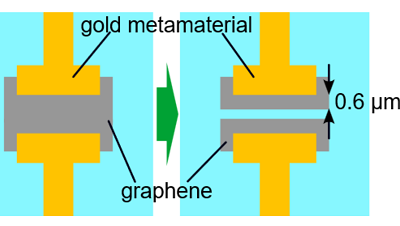
Nanoscale engineering of the resonator gaps: Creation of tunable capacitors out of graphene patches protruding from either side of the capacitor, by only 0.6 µm. Courtesy of the University of Cambridge.
“Think of how you listen to an old analog radio, which works at much larger wavelengths: you turn the dial to tune into your desired station. Inside the radio, you’re adjusting a capacitor so that the radio picks up the frequency of the station you want,” said Wladislaw Michailow, who led the research at the Cavendish Laboratory and is currently a junior research fellow at Trinity College. “This tuning concept is very useful in many devices, but because terahertz wavelengths are so small, we had to come up with a new concept to realize tuning in the terahertz range.”
Capacitors, which store and release electric energy, can be adjusted to change the amount each capacitor can hold. In doing so, it becomes possible to tune devices like detectors and modulators. As the wavelength becomes smaller, the dimensions of the capacitors need to be scaled down. But the THz range demands a smaller scale than traditional means can allow.
To address this, researchers have realized modulators using metamaterials. By embedding a conductive material like two-dimensional graphene, the optical response of such materials can be tuned, enabling modulators. Usually, graphene is used as a variable resistor in these devices: the nanoscale gaps within the resonators are shorted with graphene. This dampens the resonance and, as a result, changes the strength of the transmitted radiation.
“But this approach isn’t very efficient, as it simply causes the resonance to collapse. That’s like putting a sock on a flute, instead of playing the flute,” said Michailow. “Rather than suppressing the resonance, we created ultra-thin, tuneble capacitors from graphene. This allows us instead to shift the resonance the way we want — like playing a melody on a flute.”

The researchers from the Cavendish Laboratory created ultra-small patches made from graphene and placed them inside each tiny structure or resonator in the array of the metamaterial. These graphene patches are less than a micron wide and serve as tunable capacitors working on the nanoscale.
The researchers also designed the devices to reflect signals from its back surface, which made the performance even better.
“This way we were able to achieve a modulation depth of more than four orders of magnitude,” said Ruqiao Xia, who built and measured the devices during her Ph.D. at the Cavendish Laboratory. “This is one of the highest values ever reported in the terahertz range.”
Moreover, the demonstrated devices are also fast. Generally, it is easy to realize large modulation with slow speeds, or small modulation with large speeds, but not together. These new devices achieve an unprecedented intensity modulation depth (>99.99%) in combination with a speed of already 30 MHz.
“The performance of our devices significantly exceeds that of many comparable modulator technologies, and thanks to the use of metamaterials, we can adapt the design for use across the entire terahertz range,” said Xia.
Beyond the immediate performance improvements, the team believes its design could influence many future technologies.
“By changing the design of the nanoscale gap in any metamaterial relying on a resonator, you can significantly influence the optical response and hence improve modulation efficiency,” said Michailow. “The approach we’ve taken here could be applied to many other types of metamaterial-based modulators.”
Terahertz technologies are still in their early stages, but their potential is growing quickly.
“Terahertz waves can have many applications in material spectroscopy, security screening, pharmaceutics, medicine and terahertz communications. The aspect we focus on in our current project, Teracom, is the development of future communication systems,” said David Ritchie, head of the Semiconductor Physics Group at the Cavendish Laboratory. “These results are a big step forward towards the realisation of next generation communication systems, beyond the era of 5G and 6G.”
The research was published in Light: Science and Applications (www.doi.org/10.1038/s41377-025-01945-4).