
SCIX Plots the Journey from Analysis to Discovery
From a keynote talk focusing on the pursuit of unidentified anomalous phenomena (UAPs) to individual academic sessions delving into the use of spectroscopy to uncover evasive clues in infectious diseases, the theme of SCIX 2025 will revolve around unlocking some of the mysteries of science in biomedicine and beyond. The conference, hosted by the Federation of Analytical Chemistry and Spectroscopy Societies (FACSS), will be held from Sunday, Oct. 5, to Friday, Oct. 10, at the Northern Kentucky Convention Center in Covington, Ky.
The event will feature a host of award presentations from FACSS member organizations, as well as a masquerade ball — a gala that program chair Brooke Kammrath said will fit with the event’s mystery of science theme. Costumes are encouraged but not required at the gala.
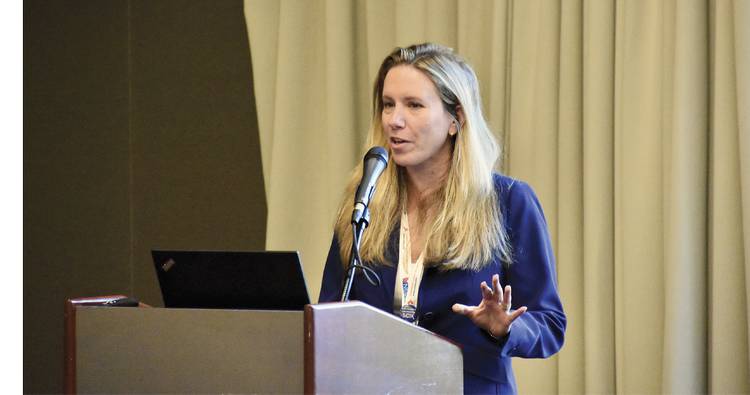
Brooke Kammrath from the University of New Haven, seen here speaking at last year’s
event, is serving as the program chair for SCIX 2025. Courtesy of Glen Jackson/FACSS.
“The mystery of science is the theme — and answering the big questions,” Kammrath said. “And Mike Gold, our keynote speaker, will address some of the big questions surrounding UAPs. I saw him speak before Congress [regarding] how NASA could release some of their observations to the public.”
Gold is the chief growth officer at Redwire, a company devoted to building reliable infrastructure for missions in space. He was previously NASA’s associate administrator for space policy and partnerships and was awarded NASA’s Outstanding Leadership Medal in 2021. In 2022, he was appointed to serve on the agency’s Unidentified Anomalous Phenomena Independent Study Team, which sought insight into these events and/or entities.
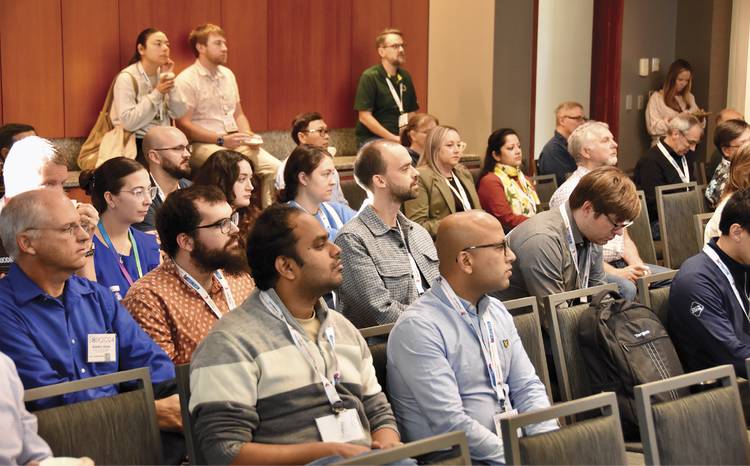
Conference attendees listen during one of the many sessions at SCIX. Courtesy of Glen Jackson/FACSS.
Researchers, scientists, and engineers have long attended the trade show component of SCIX, which features some of the latest advancements in spectroscopy. Companies such as Armadillo SIA, Chroma Technology, Hamamatsu Corp., JASCO, Metrohm, Oxford Instruments, and Teledyne will occupy the exhibit hall.
Session tracks
Though Kammrath acknowledged that the uncertainty surrounding research funding has somewhat limited the participation of academic groups, plenty of sessions will take place in areas including: AES Electrophoresis; Art & Archaeology; Atomic Spectroscopy; Biomedical; Chemometrics; CTP/Early Career; Forensics; Molecular Spectroscopy; Mass Spectrometry; Process Analytical Technology; Pharmaceutical Analysis; Raman Spectroscopy; and Surface Plasmon Resonance — Plasmonics.
Kammrath said that scientific storytelling will be emphasized, with contributions from Glen Jackson, the Ming Hsieh Distinguished Professor of Forensic and Investigative Science at West Virginia University.
“In the scientific community, it is incumbent upon us to explain what we do to the population at large as well as public policymakers, and to emphasize scientific literacy — and that’s one of the messages we hope to send in this conference,” Kammrath said.
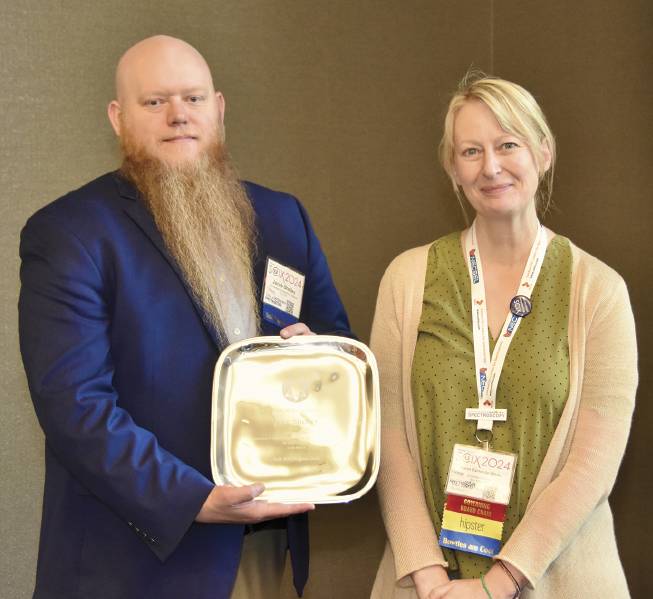
Jacob Shelley of Rensselaer Polytechnic Institute (left), the program chair for last year’s event, is presented with a service award from Karen Esmonde-White, last year’s governing board chair at SCIX. Courtesy of Glen Jackson/FACSS.
The Biomedical track will be chaired by Fay Nicolson, a research fellow at Dana-Farber Cancer Institute and Harvard Medical School, and Jürgen Popp, scientific director at the Leibniz Institute of Photonic Technology.
“The lineup this year looks exceptionally strong and innovative, covering groundbreaking advancements at the intersection of spectroscopy, imaging, and AI-driven diagnostics,” Popp said.
Sessions within the track will include:
• “Machine and Deep Learning for Biomedical Diagnostics,” with Oxana Klementieva of Lund University, and Shuxia Guo and Oleg Ryabchykov of the Leibniz Institute of Photonic Technology;
• “Translation of Multimodal Imaging Technologies into Clinical Routine,” with Laura Marcu and Alba Alfonso Garcia of the University of California, Davis, as well as Popp;
• “Point-of-Care Technologies for Biomedical Applications,” with Igor Lednev of the University at Albany, State University of New York, and Mihaela Zigman of the Max Planck Institute of Quantum Optics;
• “Spectroscopy and the Role it Plays in Commercialization of Nextgen Therapeutics,” with Andrew Whitley from HORIBA, and John Wasylyk, retired from Bristol Myers Squibb;
• “Illuminating Health: Optical Innovations in Disease Management,” with Girish Hiremath of Vanderbilt University Medical Center, and Samuel Mabbott of Texas A&M University;
• “Nanomaterials for Disease Detection and Treatment,” with Pietro Strobbia of the University of Cincinnati, as well as Nicolson.
Awards presentations
A number of award winners will be announced throughout SCIX. Among them will be the Charles Mann Award for Applied Raman Spectroscopy, awarded by FACSS and presented to Marc Porter, Distinguished Professor of Chemical Engineering at the University of Utah. Porter’s laboratory is known for its applications of surface-enhanced Raman spectroscopy as a read-out tool used in multiplexed human and animal health care testing.
The winner of the SAS and Applied Spectroscopy William F. Meggers Award for an outstanding paper in applied spectroscopy will also be recognized, which this year was awarded to Naoto Nagai, a professor in the Niigata University Graduate School of Science and Technology. Nagai wrote the paper, “Azimuth Angle Dependence of Polarized Infrared Spectra of Injection-Molded Polyoxymethylene.”
SCIX will also offer a variety of short courses, ranging from topics such as an “Introduction to Infrared, Raman, and Near-Infrared Spectroscopy” and “Spectral Interpretation of Vibrational Spectra” to “Sample Selection Design of Experiments (DOE) for Multivariate Calibration” and “Sharing Science with Broader Audiences.”
For more information, visit www.scixconference.org.
Published: September 2025