
SmaraQ Project Advances Quantum Optics On-Chip, Targets Next-Gen Computing Supply Chain
FREIBURG IM BREISGAU, Germany, Nov. 18, 2025 — QUDORA Technologies GmbH, AMO GmbH, and Fraunhofer Institute for Applied Solid State Physics IAF (Fraunhofer IAF) have joined forces to develop integrated photonic components for ion-trap, or trapped ion quantum computers. Funded by the Federal Ministry of Research, Technology, and Space (BMFTR) through 2028, the partners kicked off the SmaraQ project in September.
As ion-trap quantum computing systems grow larger, it becomes increasingly difficult to maintain precise optical access to each qubit for initialization and laser cooling. Today, control is achieved using free-space laser beams from large, complex optical systems. This approach limits both the maximum processor size and the total number of qubits that can be managed. SmaraQ aims to address this challenge by developing UV waveguides and photonic components based on aluminum nitride (AlN) and aluminum oxide (Al2O3) that can be integrated directly onto ion-trap chips.
The project brings together complementary expertise: QUDORA Technologies serves as the coordinator and system integrator, and is responsible for advancing the technology towards market readiness beyond the project timeline. Fraunhofer IAF conducts materials research and produces epitaxial growth of thin-film AlN wafers. AMO GmbH leverages cutting-edge nanotechnology fabrication capabilities to develop the photonic components on the chips.
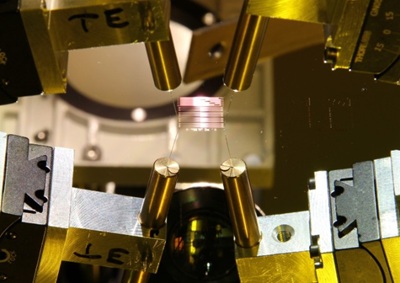
In the SmaraQ project led by QUDORA Technologies, AMO, and Fraunhofer Institute for Applied Solid State Physics IAF (Fraunhofer IAF), collaborators will develop UV waveguides and photonic components based on aluminum nitride and aluminum oxide that integrate directly onto ion-trap chips. Courtesy of Fraunhofer IAF.
/Buyers-Guide/AMO-GmbH/c19136