MELBOURNE, Australia, Sept. 2, 2025 — A vortex — whether a whirlpool spinning in a river or a tornado swirling through the sky — doesn't just spin on the spot. Rather, it travels forward while maintaining its central spiraling motion. An optical vortex, generated by passing a beam of light through a special material to induce twisting, is able to carry more information than ordinary light, opening the door to faster internet and ultra-secure communications.
Current optical vortex generators rely on expensive and complex manufacturing techniques or bulky crystals. But a research team at the University of Melbourne has found a way to generate optical vortices using cheap, ultra-thin materials.
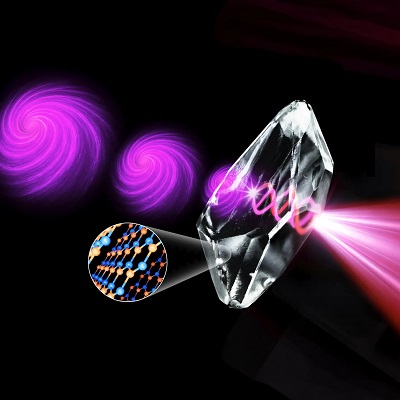
Passing circularly polarized light through certain van der Waals materials causes the beam to spiral. Courtesy of Melbourne.
The team's van der Waals (vdW) materials are composed of layers that stick to each other through what's known as van der Waals force — the intermolecular force that allows spiders to walk on a ceiling without falling. It's strong enough to hold the layers together, but weak enough that they can easily be pulled apart and reconfigured. The developed method works without the need for nanofabrication. Instead, the researchers utilized the natural optical properties of the vdW materials to change the shape of the light as it passes through. The team found that when circularly polarized light enters thin vdW crystals, the direction of its spin flips, and it gains a spiral twist, turning it into an optical vortex. This happens because the vdW materials slow the light down in different ways, depending on how it enters — a property known as birefringence. This was demonstrated using two common vdW materials: hexagonal boron nitride (hBN) and molybdenum disulfide (MoS2).
By shining laser beams through the materials, the team was able to generate well-defined optical vortex beams, even in 8-μm thick hBN samples and 320-nm thick MoS2 samples. The method works efficiently, converting almost half of the incoming light into twisted beams. Computer simulations have suggested that the researchers could push the efficiency even higher by changing the shape of the light beam before it enters the material.
The research could have implications for high-speed communications due to the spiral structure optical vortices have, which offers another dimension for encoding information. The work could lead to smaller, cheaper, more scalable optical devices that could be integrated into future communication systems, including satellites.
Future work will focus on improving the conversion efficiency, making the system compatible with existing communication technologies, and exploring how to integrated it into larger optical systems.
The research was published in Light: Science & Applications (www.doi.org/10.1038/s41377-025-01926-7)