About This Webinar

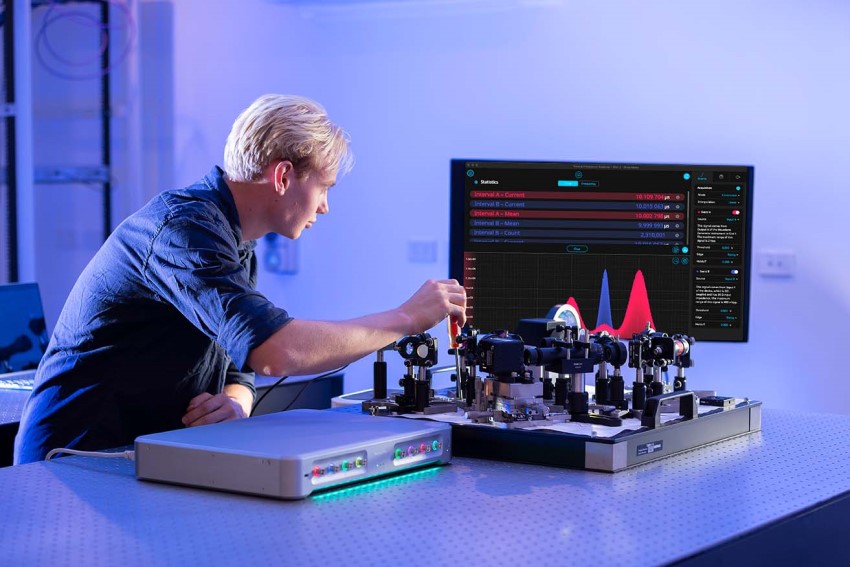
Quantum sensing leverages the fundamental quantum behavior of atoms and light to measure weak signals with precision beyond that of classical methods. These measurements use trapped ions and cold atoms, and include applications such as magnetic field sensing, optical atomic clocks, and quantum gravimetry. Critical to these techniques are ultracold temperatures, coherent quantum control, and sensitive optical readout, which pose significant hardware challenges with regard to laser stabilization, timing, and noise suppression. During this presentation, learn about how to generate and detect synchronized radio frequency pulse trains, such as a Ramsey sequence, using a software-defined waveform generator and lock-in amplifier. Plus, learn about new ways to stabilize your systems with a laser lock box and measure clock stability with a phasemeter, using a reconfigurable suite of instruments in a single device. Finally, in a live demonstration, learn how to deploy these instruments simultaneously for maximum flexibility, and how to use Python to interface with each. A Q&A session will conclude the presentation.
Benefits of attending the webinar:
- Learn about quantum sensing applications using cold atoms and trapped ions.
- See how field-programmable gate array-based hardware can address some of the hurdles to implementation.
- Discover how to configure experimental setups for different modalities and applications.
Come learn how to implement pulse sequencing, detection, and stabilization techniques with reconfigurable, software-defined instrumentation.
Who should attend:
Those who work with research & development, engineering and test and measurement, and quality control. Academic researchers in optical quantum information science. Researchers working in quantum sensing for industrial and defense applications. Students who want to learn more about techniques and instrumentation. Those who work in aerospace, defense, medical, and nano fields.
About the presenter:
 Dr. Jason Ball is an engineer at Liquid Instruments, where he focuses on applications in quantum physics, particularly quantum optics, sensing, and computing. He holds a Ph.D. in physics from the Okinawa Institute of Science and Technology and has a comprehensive background in both research and industry, with hands-on experience in quantum computing, spin resonance, microwave/radio frequency experimental techniques, and low-temperature systems.
About the sponsor:
Developing complex technologies requires increasingly sophisticated test systems, but the uniqueness of most applications demands adaptable, customized configurations. Traditional multi-instrument setups add significant cost and time, both upfront and throughout the test cycle. Liquid Instruments’ reconfigurable Moku is the only integrated test solution engineered for seamless customization — whether for simple tests or intricate multi-instrument environments. Used in hundreds of labs worldwide, Moku accelerates the journey from idea to implementation by an order of magnitude, cutting the time and cost of advanced research and development. Designed by researchers for researchers, Moku delivers unparalleled efficiency in today’s most complex test scenarios while adapting to your evolving needs in the future. Experience Moku cost-free by visiting www.liquidinstruments.com.